Ai
Codehouse

Claus Meldgaard Rasmussen
,

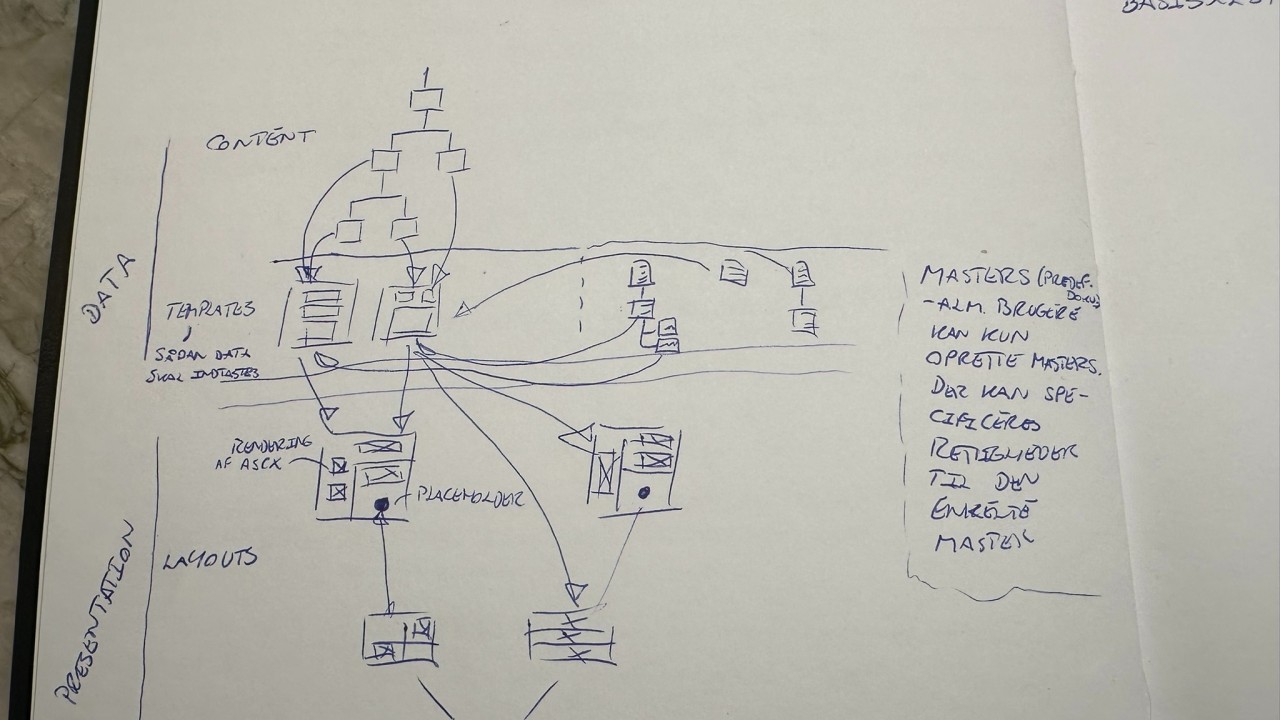
The sketch above is from a notebook I found the other day while cleaning out; it's dated 27 November 2002 – my first day on a Sitecore Certified Developer course (SCD1, mind you), taught by Sitecore co-founder Lars Fløe Nielsen in a meeting room in suburban Birkerød, north of Copenhagen. The doodle is me trying to make sense of how the whole Sitecore thingy fitted together.
Sitecore turns 25 this year, and Codehouse – myself included – has been there for almost all of it; coming up to 24 years for my part, judging by the date stamp. And standing here in 2026, looking at where the platform, the ecosystem and the web itself have ended up, my reaction is simply is a slightly bewildered laugh.
The early years
I feel like I've seen it all: early installs of an almost pre-Sitecore version 3, the 4.x era, the big rewrite that gave us the then-novel Win XP look – desktop and all, in a browser! Big names coming onboard, new countries on Sitecore's roster, and us partners joining in on the fun, taming the beast and getting it to deliver for expectant customers.
I was lucky enough to make it onto the Sitecore Instructor circuit, training a few (hundred) developers alongside my Codehouse colleagues – including, I seem to remember, one Tamas Varga , certified by me at 10 Philpot Lane, London.
From XSLT to Next.js
If you've come into the Sitecore world in the last few years, "XSLT" and "ASCX" probably mean nothing to you. Consider yourself lucky. The rest of us carry the scars.
That's what lands hardest about 25 years in this industry: An entire era of the web goes obsolete quietly, until one day nobody on the team has ever written a postback handler – or knows what one is.
WebForms gave way to MVC. Helix and Habitat taught a generation to think in modules and clean boundaries; SXA standardised the visual side. Each shift felt enormous, each demanded real investment from agencies like ours, and each, in retrospect, was a stepping stone.
A Codehouse Sitecore project in 2026 looks nothing like that 2002 sketch: Composable, headless, likely Next.js on the front, pipes into cloud infrastructure that didn't exist when we started. Sitecore has earned its longevity by reinventing itself before it had to, repeatedly. Most software from 2002 isn't just gone, it's forgotten. Sitecore is still here because it kept making the leap.
And now, AI
Which brings us to the next chapter, already well underway. Sitecore's own AI investments – and the broader wave of AI tooling we now use daily at Codehouse – aren't replacing the platform; they're taking the grind out of it. Content generation, translation, image work, code scaffolding, test writing, the mechanical parts of migrations – work that used to eat weeks is now measured in hours.
That changes what an agency is for: less time on the mechanical, more on what actually moves the needle for a client – strategy, design, the genuinely hard architectural calls, the parts where judgement matters more than throughput. We're betting heavily on that shift, and rolling AI tooling out across the team.
If the last 24 years are any guide, this transition will look obvious in hindsight and feel disorienting in the middle. That's roughly where we are.
What hasn't changed
The technology stack has been rebuilt, what, four times(?), and the platform has changed almost beyond recognition. What hasn't changed is the bit that actually matters: The community of people in this ecosystem. The clients who trust us to get it right. The partners who turn up year after year. The team at Codehouse who have, between them, built and shipped more Sitecore than most people will see in a career.
To Sitecore – congratulations on 25. To Michael, Lars, Thomas and the rest of the founding team, Pentia or otherwise: Thank you for taking on Codehouse as a partner all those years ago, and for that course in Birkerød, November 2002.
And to everyone who's been part of the journey – clients, partners, colleagues past and present – thank you!
Here's to the next 25! (Whether I'll be part of all of them… well…)