DXPlaybook
Play 5: Customer Acquisition & Growth

Technology
Codehouse
Events
Marketing

Technology
Codehouse
Events
Marketing

Technology
Codehouse
Events
Marketing

Technology
Codehouse
Events
Marketing

<< You’re here
Technology
Codehouse
Events
Marketing

Technology
Codehouse
Events
Marketing
DXPlaybook is Codehouse’s practical guide to running an enterprise‑grade digital experience with less drama and more certainty. It is written for leaders and senior specialists across marketing, product, digital, content, design, engineering and analytics, with enough depth that delivery teams can act on it. Each play turns a fuzzy ambition into something visible, ownable and repeatable.
This page is Play 5. It focuses on how customers find, engage and convert — and on the handover after conversion. We look at the full path from first touch to opportunity and sale: on‑site conversion patterns, consent and attribution, lead capture and enrichment in marketing automation (MA), reliable routing and deduplication into customer relationship management (CRM), sales acceptance and onboarding. The emphasis is on the joins: make the on‑site moment dependable, make the MA→CRM handover clean, and make feedback loops visible so spend turns into revenue with fewer surprises.
Why this play matters
Acquisition is getting more expensive across every channel. Weak joins waste that spend: shaky on‑site conversion, unclear consent, duplicate or unqualified records, slow routing, and handovers that vanish into queues. The result is missed follow‑ups, unreliable attribution and a disconnect between what marketing funds and what sales can close.
This play tackles those joins head‑on. It treats the on‑site conversion pattern (for example, enquiry submit, sign‑up and first‑run activation, demo request) as a product with clear guidance, respectful errors, explicit consent and dependable events. It standardises what happens next: capture in MA, enrich and score, deduplicate, and route to CRM based on rules you can see and audit. Sales acceptance and follow‑up are governed by service‑level agreements, with outcomes fed back so targeting and spend improve.
The aim is not to add process. It is to make the path from intent to revenue visible and repeatable, so teams can fix the slowest join first. When on‑site conversion is consistent and handover is clean, leaders see steadier pipelines, faster response, and clearer performance insight by channel and message. When feedback loops are short, growth decisions become lighter and evidence‑led.
What this play covers
From find to engage — clarify channels, audiences and messages; make landing experiences fast and explicit about the primary action.
From engage to convert — apply a standard conversion pattern with consent, validation, helpful errors, and first‑party events in a documented data layer.
From convert to handover — capture in MA, enrich, score, deduplicate and route to CRM with required fields and an audit trail.
From handover to acceptance — define sales acceptance criteria and SLAs; surface failed routes and stale leads; close the loop on outcomes.
From acceptance to onboarding — ensure the first experience as a customer reflects what was promised; capture early health signals.
From learn to optimise — review trends in conversion reliability, routing, acceptance and cycle time; decide what changes next.
What good looks like
Clarity up front — the audience, message, proof and primary action are explicit and tested.
Consistent conversion — one behavioural standard across forms and sign‑ups, with consent and events applied the same way everywhere.
Clean handover — MA owns forms, enrichment, scoring and deduplication; CRM receives complete records in the right queue within SLA.
Trusted data — attribution is based on a documented data layer and consented tags; reports reconcile with MA and CRM.
Short loops — weekly visibility of conversion reliability, routing, acceptance and outcomes; fixes land as first increments.
Questions to ask
This section gives marketing, digital and sales leaders a simple way to diagnose how acquisition really works today. It focuses on the joins: the on‑site conversion moment, the handover into MA and then CRM, and the first follow‑up. Use it in one session or asynchronously. For any answers you plan to act on, capture Owner, Evidence link, Status and Next step so improvements are visible and accountable.
Quick triage
How long does a typical conversion take to receive a personalised follow‑up (from submit to first human touch)?
Is our critical conversion step reliable across devices and regions (completion rate, common errors, success events present)?
Do MA and CRM agree on the number of new leads and opportunities this week, and can we explain any deltas?
What percentage of routed leads meet sales acceptance criteria on first pass?
Channels, landing and intent capture
Which channels actually drive qualified traffic (not just clicks), and what is the primary action per channel?
Do landing pages load fast and make the primary action obvious, with proof that matches the promise?
Are forms respectful (progressive where possible) with inline guidance and clear error handling?
Do we test variants regularly, and do we stop low performers instead of piling on more variants?
Consent, attribution and events
Is consent captured once via the consent management platform and enforced by the tag manager across all tags?
Is the data layer documented and consistent for view, interaction, error and success, and are events verified on each release?
Do we use first‑party attribution that reconciles with MA and CRM, and can we trace one example from click to opportunity?
Capture in MA: enrichment, scoring and deduplication
Do all forms write to MA first (never directly to CRM), and are required fields populated for sales acceptance?
Do any forms write directly to CRM today, and if so, where and why?
Which third‑party enrichments run (for example, firmographics), and are they adding accuracy, not noise?
Is lead scoring simple, explainable and tuned against real sales outcomes, and when was it last reviewed?
Is deduplication working, and are merge rules clear and logged?
Routing to CRM and ownership
Are routing rules explicit and auditable (who owns them, where are they stored, when were they last tested)?
What is the SLA for routing into CRM and for sales pick‑up, and how often do we miss it by segment or region?
Do we enrich owner hand‑offs with context (source, campaign, last touch, consent state) so follow‑ups are relevant?
Sales acceptance and follow‑up
What are our sales acceptance criteria by segment, and do they match what MA collects?
What percentage of leads are accepted on the first touch, and why are the rest rejected or recycled?
How long do rejected leads take to return to nurture, and is the reason captured in a way marketing can act on?
Onboarding and first value
Does the first customer experience reflect what was promised on the site (content, pricing, timelines)?
Do we capture early health signals (for example, first login, first use, first meeting) and feed them back into targeting?
Are there clear owners for hand‑offs into onboarding or customer success?
Feedback loops and learning cadence
Do we review conversion reliability, routing errors and sales acceptance weekly with both teams present?
Do we test one change at a time and follow up with a decision (keep, roll back, iterate) rather than stacking changes?
Are insights written down in a place that outlives people and campaigns?
Red flags to watch
Forms write directly to CRM; MA is bypassed.
Consent gated inside MA rather than via CMP and tag manager; analytics events vary by page.
Duplicate or incomplete records in CRM; owners reassign leads manually.
Slow or absent follow‑up; acceptance criteria unclear; reject reasons missing.
MA and CRM numbers never reconcile; attribution changes from deck to deck.
Good patterns
These patterns make acquisition more efficient from first touch to sale. They are deliberately practical and work across campaigns, segments and regions. Start with the basics and deepen only where outcomes demand it.
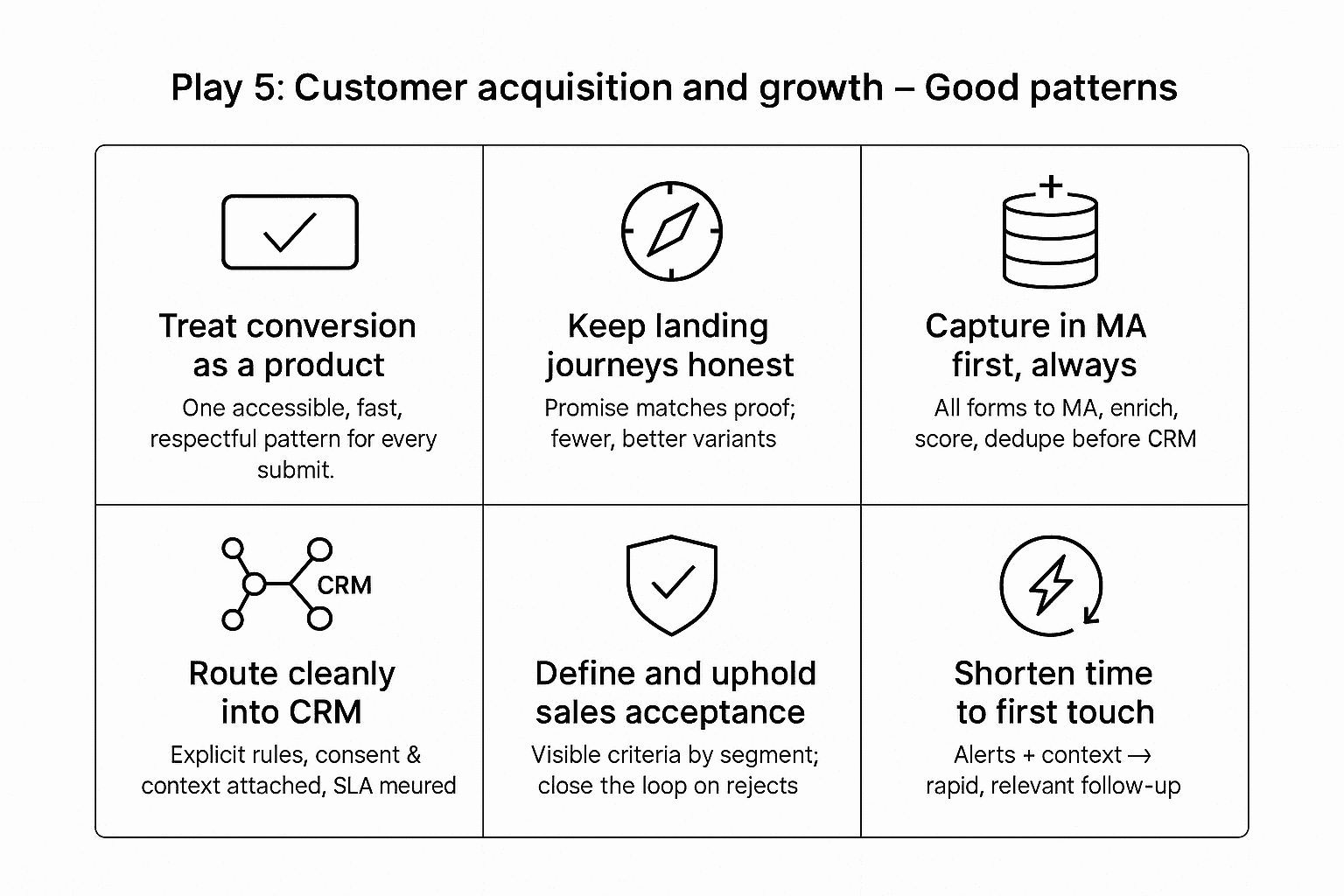
Treat conversion as a product
Design one conversion pattern and apply it everywhere (enquiry submit, demo request, sign‑up). Make it accessible, fast and respectful.
Make the primary action explicit and reduce fields to the minimum.
Provide inline guidance and friendly, precise error states.
Capture consent explicitly and store it with the record.
Emit first‑party events for view, start, error and success from a documented data layer.
Keep landing journeys honest
Align the promise in the ad or email with the proof on the page. Fewer, better variants beat sprawling test matrices.
Hold performance budgets on key templates; protect Core Web Vitals.
Reuse components and proof elements; avoid ad‑hoc page builds.
Test meaningfully (for example, a stronger proof or clearer action), not tiny cosmetic tweaks.
Capture in MA first, always
Make MA the front door for all form submits. Do enrichment, scoring and deduplication there before anything reaches CRM.
No direct‑to‑CRM writes. Every form posts to MA; CRM only receives routed, enriched and deduplicated records.
Attach consent and attribution at capture. Persist CMP/tag manager consent and first‑party source/campaign with the MA record.
Keep an audit trail. Log merges, enrichment and routing decisions so issues can be traced and fixed quickly.
Enforce required fields for sales acceptance at the point of capture.
Keep scoring simple and explainable; calibrate against real win/loss data.
Route cleanly into CRM
Keep routing rules explicit, owned and testable. Aim for fast, accurate hand‑offs that respect consent and context.
Route by segment, territory or product with clear fallbacks.
Attach campaign context, last touch and consent state to each record.
Measure and publish SLA adherence for routing and first response.
Define and uphold sales acceptance
Create a shared definition of a sales‑accepted lead per segment and make it visible. Close the loop on rejects and recycled leads.
Publish the criteria, owner and SLA for acceptance.
Capture reject reasons in a controlled list and review trends.
Return non‑accepted leads to nurture with a clear next step.
Shorten time to first touch
Speed matters. Rapid, relevant follow‑up increases conversion and makes spend work harder.
Use alerts and simple queues; avoid complex round‑robins that create waits.
Provide context to the owner (what they saw, what they did, what they consented to).
Offer helpful next steps (calendar link, light‑weight discovery form, trial) rather than “we’ll be in touch.”
Make attribution useful, not perfect
Leaders need a trustworthy trend, not a fantasy of precision. Favour first‑party data and reconciliation over brittle last‑click myths.
Base reporting on the data layer and consented tags; reconcile with MA and CRM weekly.
Track a small set of truths: qualified visits, conversion reliability, routed leads, acceptance rate, opportunities, wins.
Keep a notes field for judgement calls so debates do not derail action.
Guardrails for responsible automation and AI (optional)
Use AI as an assist, not an autopilot. Keep humans in the loop and protect privacy.
Draft outreach snippets or subject lines from approved copy, with human approval before send.
Never paste personally identifiable information into public tools; prefer approved endpoints.
Review models and rules quarterly against outcomes and bias.
Case study

Zuken refreshed its global website to give visitors a clearer picture of the company, a straightforward way to discover products and a smoother path to contacting the sales team. Personalisation and marketing automation were central to the redesign.
The updated site offers improved navigation and a simplified registration process. Information collected from online forms is now captured in a central database. A custom Tag Analyser tool extracts lead data according to predefined rules and automatically distributes it among resellers and direct sales representatives every 24 hours. Marketing teams can set goals and campaigns and use engagement analytics to identify visitors by location. The Tag Analyser also draws on on‑site analytics to drive personalised email campaigns. Built‑in rule sets enable targeted personalisation across the site.
The result is a modern, customer‑centric site that pairs smooth user journeys with reliable lead capture and automated distribution, demonstrating how integrated marketing automation and analytics can boost both engagement and sales pipelines without relying on outdated web form technology.
Signals and maturity
This last section is here to make progress observable without drowning anyone in dashboards. A small set of signals tells you whether the acquisition engine is working; a simple maturity view shows where you are today and what “better” looks like next. Keep it light. Review it regularly and use the trends to steer the next decision.
The signals that matter
Time to first contact
How long does it take from a form being submitted on the website to the first meaningful follow‑up by sales? This one measure exposes friction in the handover from marketing automation to customer relationship management and on to the right owner. Long waits suggest leads are queued, stuck in a manual process or routed to the wrong place.
Lead acceptance and conversion
What percentage of marketing‑generated leads are accepted by sales, and how many move from marketing‑qualified to sales‑qualified to closed? Low acceptance or falling conversion rates point to issues with deduplication, scoring, enrichment or even the form itself. Improving the quality of what you send and making acceptance explicit are levers to pull.
Data quality and attribution
Are mandatory fields, consent and campaign source captured correctly for every lead? If attribution is patchy or personally identifiable information is missing, you will struggle to trust your funnel numbers. Measure the percentage of leads with complete and accurate data, and audit for duplication or corruption when records cross systems.
Cost per acquisition and return on spend
What does it cost to acquire a lead, an opportunity and a customer, and how does that compare to the lifetime value? Rising costs or unclear ROI signal that spend is being wasted somewhere in the funnel. Use the data layer and marketing automation to attribute revenue back to source and channel.
Follow‑up cadence and nurture
How often do marketing and sales touch leads during nurture, and do those touches happen within service‑level expectations? Leads that sit untouched, or sequences that run out of steam, mean your nurture and re‑engagement loops are broken. Make cadence visible and tune it alongside lead quality.
You do not need perfect instrumentation to start. Use timestamps from forms and calls for time to first contact; your marketing automation system for acceptance and conversion; analytics for data completeness and attribution; cost and revenue data from finance; and nurture logs for cadence. Refine as you go.
How to read the signals together
Fast contact, high acceptance, clean data – The engine is working; add volume or new channels and monitor whether conversion holds.
Slow contact, low acceptance, messy data – Fix the front door and handover first; your problem is operational, not a lack of leads.
Good contact and acceptance, rising cost – Optimise channel mix and nurture; you may be paying too much for some sources.
Fast contact but poor conversion – Leads may be unqualified or expectations mis‑set; revisit your form fields, offer and scoring.
A simple maturity view
This is not a certification. It is a shared language to describe where you are and what “a bit better” looks like next quarter.
Ad hoc
Leads arrive as emails or spreadsheets; forms may write straight to customer relationship management; there is no agreed definition of marketing‑qualified or sales‑qualified; sales follow up inconsistently; metrics are anecdotal.
What changes next: post every form to marketing automation, apply deduplication and capture consent; define MQL and SQL; log acceptance in CRM.
Defined
Forms post to marketing automation; deduplication, enrichment and routing rules exist; MQL and SQL definitions are agreed; basic reports show conversion rates and cost per acquisition; first contact times are monitored.
What changes next: tune scoring and routing; make acceptance visible; start tracking data completeness and attribution quality.
Managed
Scoring and routing are automated and auditable; campaigns are tagged and attribution is consistent; first contact and acceptance meet service‑level targets; conversion rates and cost per acquisition are reviewed each cycle; nurture sequences are defined.
What changes next: shorten time to first contact by removing waits; tune nurture cadence and content; link revenue to campaigns for ROI.
Optimised
Predictive scoring uses behavioural and firmographic data; routing adjusts dynamically; personalisation and nurture adapt to intent; contact and acceptance are near real‑time; attribution is trusted and ROI is clear.
What changes next: sustain the rhythm, experiment with new channels and tactics, and share the standards with adjacent teams and partners.
Keeping it lightweight
Put the five signals and your maturity level on a single page alongside one or two sentences of commentary on what improved and what you will try next. That is enough for leaders to steer and for teams to act. The goal here isn’t more reporting; it’s clearer choices about where to focus effort in the next cycle.
Yes, please sign me up for a demo of this in action!
DXPlaybook Plays
Play 1: Business & Digital Context
Technology
Codehouse
Events
Marketing
Play 2: Experience Design & Development
Technology
Codehouse
Events
Marketing
Play 3: Platform Engineering & Enablement
Technology
Codehouse
Events
Marketing
Play 4: Content Lifecycle & Omnichannel Orchestration
Technology
Codehouse
Events
Marketing
Play 6: Measurement & Optimisation
Technology
Codehouse
Events
Marketing
Workshop template
Get access to the Miro template to use with your whole team to work through the DXPlaybook
Glossary
Lead – A contact or prospect who has shown interest in your company’s products or services, typically by filling in a form or requesting more information.
Marketing qualified lead (MQL) – A lead that meets agreed criteria for further marketing engagement, based on factors such as demographics, firmographics and behavioural signals (for example, visiting high‑value pages).
Sales qualified lead (SQL) – An MQL that has been vetted and passed to sales because it meets the threshold for a direct conversation or proposal.
Marketing automation (MA) – The platform that captures enquiries, deduplicates and enriches lead data, applies consent and attribution, and routes qualified records to sales or nurture journeys.
Customer relationship management (CRM) – The system that stores customer and opportunity records, logs interactions, and supports sales teams as they move leads through the pipeline.
Lead scoring – A method of ranking leads against a scale that represents their perceived value to the organisation, using explicit attributes (for example, seniority) and implicit behaviours (for example, downloads).
Time to first contact – The elapsed time between a lead submitting a form and the first meaningful follow‑up by sales; a key indicator of hand‑over efficiency.
Cost per acquisition (CPA) – The total cost of acquiring a new customer (or lead), calculated by dividing the total marketing spend for a campaign by the number of conversions generated.
Attribution – The practice of identifying which channels, campaigns or touchpoints contribute to a conversion, so investment can be prioritised based on demonstrable return.
Nurture sequence – A planned series of communications aimed at engaging leads who are not yet ready for sales, delivering useful content and guiding them toward a purchase decision.